
What Foods Are Feeding Colon Cancer And What's Protecting You?
If you picture chemotherapy the way it’s shown in old movies, a frail, bald patient hooked to a drip, visibly wasting away, you’re not alone. That image has stuck in the public mind for decades. And it’s exactly why so many patients sit in a clinic, newly diagnosed, and quietly wonder: is this treatment even worth it?
As a practicing Medical Oncologist, Dr. Viraj Lavingia hears this fear constantly.
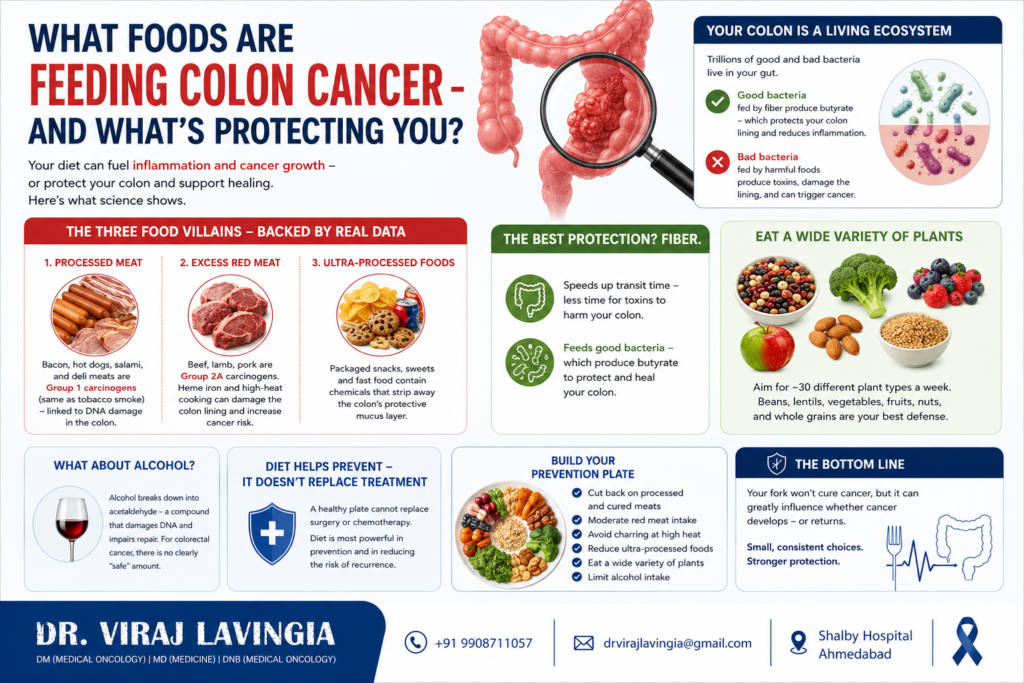
Your Colon Is a Living Ecosystem
Your colon isn’t just a passage for waste; it’s home to trillions of bacteria, fungi, and other microbes, collectively called the gut microbiome. Think of it as a densely populated city living inside you.
Every meal either feeds the “good” residents of that city or the “bad” ones.
- When good bacteria are fed well (mainly through fiber), they produce a compound called butyrate, which coats and protects the colon lining, reduces inflammation, and can even signal abnormal cells to self-destruct.
- When the wrong foods dominate your diet, harmful bacteria take over instead, producing toxins that strip away the colon’s protective lining and create chronic inflammation, which is often the spark behind cancer development.
The Three Food Villains, Backed by Real Data
This isn’t internet speculation; these classifications come from global health data.
- Processed meat: Bacon, hot dogs, salami, and deli meats are classified by the WHO as Group 1 carcinogens, the same category as tobacco smoke. When these meats are cured, smoked, or preserved with nitrates, they form compounds that can directly damage DNA in the colon lining.
- Excess red meat: Beef, lamb, and pork fall under Group 2A carcinogens, less risky than processed meat, but still significant with daily consumption. Red meat’s heme iron can irritate the colon lining and push cells to divide more frequently, raising the odds of mutation. Charring or grilling red meat at high heat adds another risk layer, producing compounds linked to cancer.
- Ultra-processed foods: packaged snacks, artificial sweets, and fast food are engineered with emulsifiers and preservatives for shelf life, but inside the body, these same chemicals can strip away the colon’s protective mucus layer, leaving it more exposed to bacterial toxins.
The Antidote Isn't a Supplement
It’s Fiber. No pill or powder replaces this. Dietary fiber works in two clear ways:
- It moves things along faster. Fiber speeds up transit time through the colon, meaning harmful substances spend less time in contact with the colon wall.
- It feeds your protective bacteria. Beans, lentils, vegetables, fruits, nuts, and whole grains are exactly what good gut bacteria need to keep producing that protective butyrate layer.
A practical target worth aiming for: around 30 different plant types a week. It sounds like a lot, but it adds up quickly; a handful of mixed nuts can count as three or four types, and one varied salad can cover seven or eight.
What About Alcohol?
Alcohol deserves its own mention. When your body metabolizes it, it converts into a compound called acetaldehyde, which damages DNA and interferes with your body’s ability to repair that damage. For colorectal cancer specifically, there is no clearly “safe” amount — risk increases with intake.
Diet Helps Prevent — It Doesn't Replace Treatment
This is an important distinction a Cancer Specialist will always be upfront about: diet is a powerful preventive tool, not a treatment substitute. A healthy plate cannot replace surgery, and it cannot replace chemotherapy if a tumor is already present and advanced.
Where diet matters most is in prevention, stopping a tumor from forming in the first place, and in survivorship, helping lower the chances of recurrence after treatment.
Building Your Own Prevention Plate
The goal isn’t to eliminate everything enjoyable from your diet. It’s about shifting the balance:
- Cut back on processed and cured meats where possible
- Moderate red meat intake, and avoid regularly charring it at high heat
- Reduce ultra-processed, packaged foods
- Build meals around a wide variety of plants, not just “more vegetables,” but more variety
- Limit alcohol intake
Small, consistent shifts matter more than occasional extreme changes. Every added plant, every swapped meal, adds another layer of protection.
The Bottom Line
Your fork won’t cure cancer, but it can meaningfully influence whether one develops in the first place, and whether it returns after treatment. If you have concerns about your personal risk or want guidance personalized to your health history, speaking with an experienced Medical Oncologist can help you build a realistic, sustainable plan.
YouTube video The Food Feeding Cancer: Why Your Diet Dictates Your Colon Health