
Can Your Diet Increase the Risk of Colorectal Cancer?
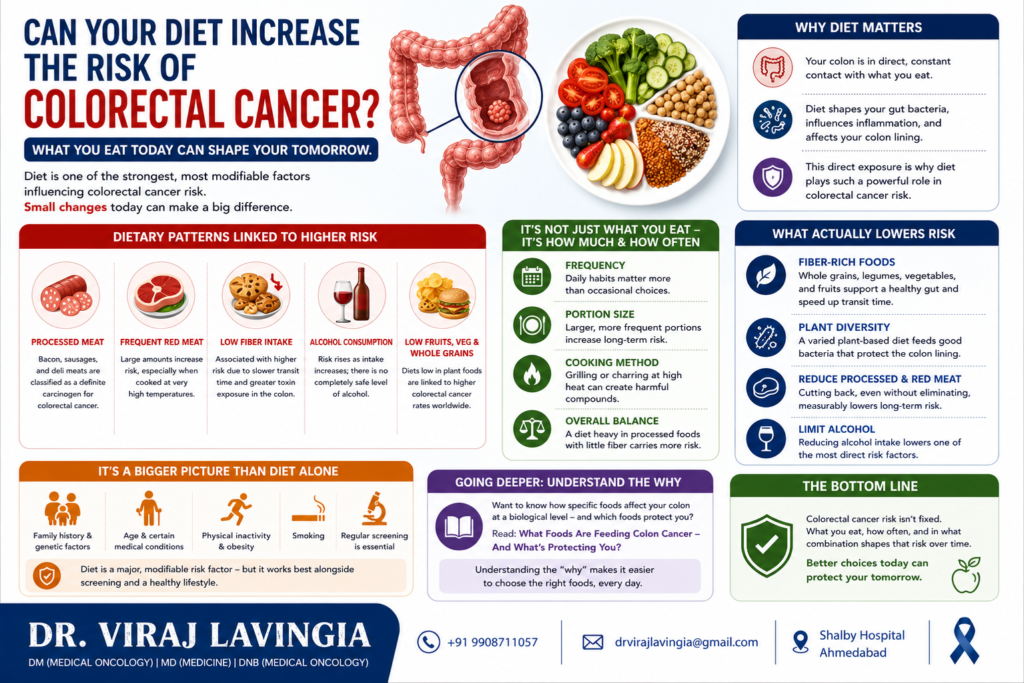
It’s a question that comes up in almost every consultation: “Doctor, did something I ate cause this?” It’s a fair question, and an important one because the honest answer is yes, diet can meaningfully influence your risk of colorectal cancer. Not as a single cause, but as one of the strongest, most modifiable factors we know of.
Dr. Viraj Lavingia often tells patients that colorectal cancer isn’t caused by one bad meal or one “unhealthy” week; it’s shaped by patterns repeated over years. Understanding those patterns is where prevention actually begins.
Why Diet Matters So Much for This Particular Cancer
Unlike some cancers where diet plays a smaller, indirect role, colorectal cancer develops in an organ that comes into direct, constant contact with everything you eat. Your colon isn’t a passive tube; it’s lined with tissue that reacts to what passes through it, and it hosts a vast community of bacteria that respond directly to your food choices.
This direct exposure is exactly why researchers have been able to establish clearer links between diet and colorectal cancer than with many other cancer types.
What the Research Actually Shows
A few dietary patterns consistently show up in global health data as risk factors worth taking seriously:
- High intake of processed meat, bacon, sausages, and deli meats has been classified by international health bodies as a definite cancer-causing factor for colorectal cancer specifically.
- Frequent consumption of red meat in large amounts is linked to increased risk, particularly when cooked at very high temperatures.
- Low fiber intake is consistently associated with higher rates of colorectal cancer, since fiber affects how quickly waste moves through the colon and what it’s exposed to along the way.
- Regular alcohol consumption is another well-documented contributor, with risk rising as intake increases; there isn’t a level considered entirely risk-free.
- Diets low in fruits, vegetables, and whole grains are repeatedly associated with higher colorectal cancer rates across large population studies.
It's Not Just What You Eat & It's How Much and How Often
Two people can eat similar foods and end up with very different risk levels, depending on:
- Frequency: occasional red meat is very different from daily consumption.
- Portion size: larger, more frequent portions compound exposure over time.
- Cooking method: grilling or charring at high heat can create additional harmful compounds.
- Overall dietary balance: a diet heavy in processed foods with little fiber carries more risk than one with more variety and plant-based foods, even if occasional red meat is included.
Going Deeper: The Specific Foods Worth Watching
The patterns above are backed by research, but knowing the why behind them makes it easier to actually act on. Processed meat, excess red meat, and ultra-processed foods don’t just add empty calories; they interact directly with your gut lining and the bacteria living there, creating conditions that make colorectal cancer more likely to take hold over time.
Dr. Viraj Lavingia breaks down exactly how these specific foods affect your colon at a biological level and which foods actively work in your favor instead in What Foods Are Feeding Colon Cancer And What’s Protecting You? It’s worth a closer look if you want to understand not just what to avoid, but why it matters.
What Actually Lowers Risk
The encouraging side of this research is that protective dietary habits are just as well established as the risk factors:
- Fiber-rich foods whole grains, legumes, vegetables, and fruits support a healthier gut environment and speed up transit time through the colon.
- A varied plant-based intake feeds beneficial gut bacteria, which produce compounds that help protect the colon lining.
- Reducing processed and red meat frequency, even without eliminating it, measurably lowers long-term risk.
- Limiting alcohol reduces one of the more direct, well-documented risk contributors.
Diet Is One Piece of a Larger Picture
It’s worth being clear-eyed here: diet is a major, modifiable risk factor for colorectal cancer, but it isn’t the only one. Family history, age, certain inherited conditions, and lifestyle factors like physical activity and smoking all play a role too.
This is why dietary changes work best alongside, not instead of, routine screening, especially for anyone with a family history of colorectal cancer or other known risk factors. A conversation with an experienced oncologist can help clarify what your personal risk profile actually looks like, rather than relying on general assumptions.
Colorectal cancer risk isn’t fixed. What you eat, how often, and in what combination genuinely shapes that risk over time, which means there’s real, meaningful room to act, starting with the next meal on your plate.