
Is Blood in Stool Always a Sign of Rectal Cancer?
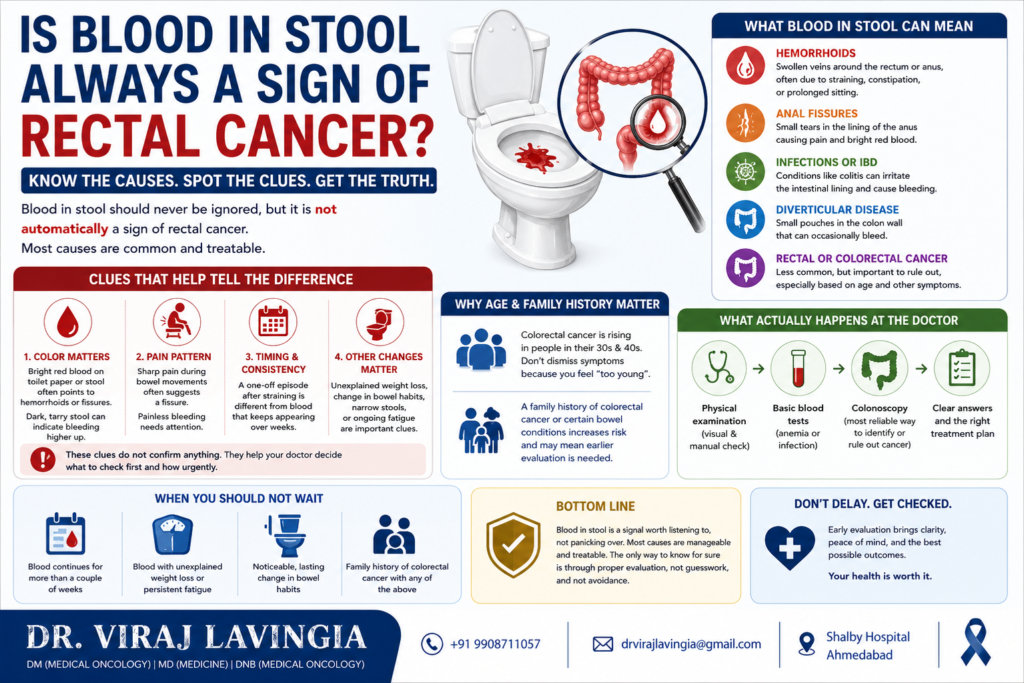
Seeing blood when you use the washroom is one of those moments that can genuinely stop you in your tracks. Your mind jumps straight to the worst-case scenario. But here’s something worth knowing upfront: blood in stool, while it should never be ignored, is not automatically a sign of rectal cancer.
As a medical oncologist, Dr. Viraj Lavingia sees this fear play out often, with patients delaying a visit out of dread, or rushing in convinced the worst has already happened. The truth sits somewhere calmer and more useful than either extreme.
What Blood in Stool Can Actually Mean
Blood in the stool has several possible causes, and most of them are far more common and far less serious than cancer.
- Hemorrhoids — swollen veins around the rectum or anus, often caused by straining, constipation, or prolonged sitting. This is, by far, the most frequent cause of visible blood.
- Anal fissures — small tears in the lining of the anus, usually from passing hard stool, which can cause sharp pain along with bright red blood.
- Infections or inflammatory bowel conditions — such as colitis, which can irritate the lining of the intestine.
- Diverticular disease — small bulging pouches in the colon wall that can occasionally bleed.
- Rectal or colorectal cancer — a less common, but important, cause that needs to be ruled out, especially depending on age and other symptoms.
Clues That Help Tell the Difference
While only a proper examination can give a definitive answer, a few patterns can offer early clues:
- Color of the blood matters: Bright red blood, especially seen on toilet paper or coating the stool, often points toward hemorrhoids or fissures. Darker, tarry-looking stool can indicate bleeding higher up in the digestive tract and needs prompt evaluation.
- Pain pattern is a clue: Sharp pain during bowel movements often suggests a fissure. Painless bleeding is actually one of the patterns doctors pay closer attention to.
- Timing and consistency count: A one-off episode after straining is different from blood that keeps appearing over weeks.
- Other changes in bowel habits matter too: such as unexplained weight loss, persistent changes in stool shape or frequency, or ongoing fatigue.
None of these clues alone confirm anything. They simply help a cancer doctor decide what to check first and how urgently.
Why Age and Family History Change the Picture
Colorectal cancer has traditionally been associated with older adults, but this is shifting; a growing number of cases are now being diagnosed in people in their 30s and 40s. This makes it especially important not to dismiss symptoms simply because someone feels “too young” for cancer.
Family history also plays a meaningful role. If a close relative has had colorectal cancer or certain inflammatory bowel conditions, that raises the case for earlier and more thorough evaluation.
What Actually Happens When You See a Doctor
A lot of the fear around this symptom comes from not knowing what the process looks like. In reality, it’s usually straightforward:
- A physical examination, including a simple visual and manual check
- Basic blood tests to rule out anemia or infection
- In many cases, a colonoscopy, a procedure that allows direct visualization of the colon and rectum lining, and is considered the most reliable way to identify or rule out cancer
A colonoscopy sounds intimidating to many people, but it’s a well-established, routine procedure and often the fastest way to get a clear, reassuring answer rather than living with uncertainty.
When You Should Not Wait
While a single, minor episode tied to straining is usually not urgent, certain situations call for prompt medical attention:
- Blood that continues over more than a couple of weeks
- Blood accompanied by unexplained weight loss or persistent fatigue
- A noticeable, lasting change in bowel habits
- A family history of colorectal cancer, combined with any of the above
In these situations, seeing a Dr. Viraj Lavingia sooner rather than later isn’t about assuming the worst; it’s about ruling it out quickly and confidently, one way or the other.
Blood in the stool is a signal from your body worth listening to, not panicking over. Most of the time, the explanation is manageable and treatable. But the only way to know for sure is through proper evaluation, not guesswork, and not avoidance.