
Can a Simple Blood Test Really Detect Cancer Early?
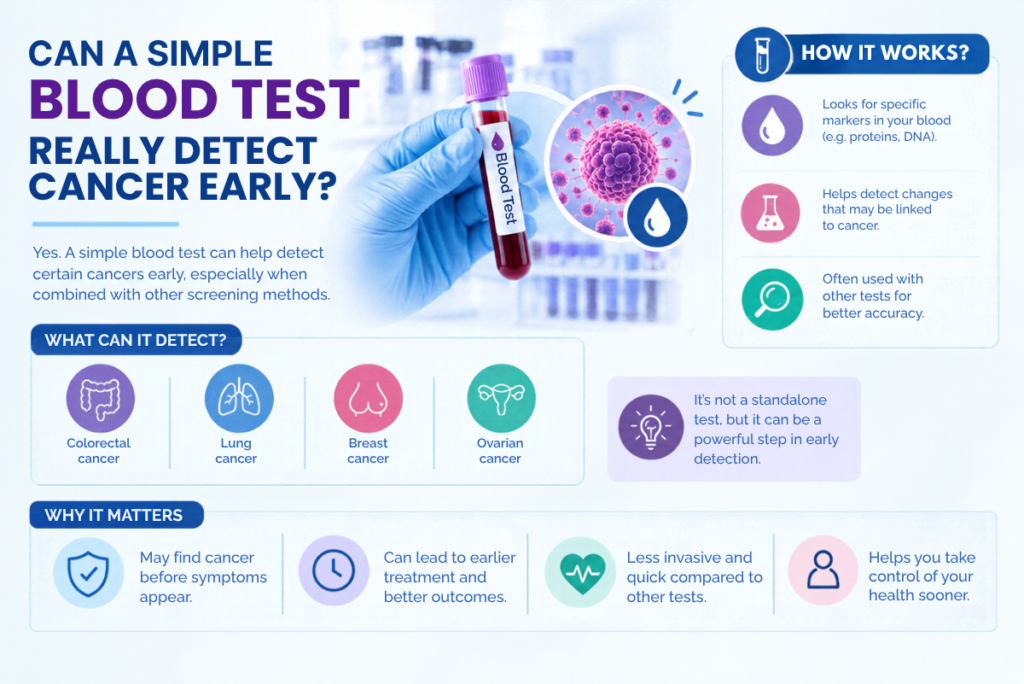
Imagine catching cancer the way you catch high cholesterol: a routine blood draw during your annual check-up. That idea is no longer science fiction.
Blood tests for cancer detection are here, and they are changing how doctors think about early cancer screening. Dr Viraj Lavingia, who treats colorectal cancer, explains what these tests can and cannot do.
How Does a Blood Test Find Cancer?
Tumours are messy. Their cells die and are replaced constantly, and when a cancer cell dies, it releases tiny fragments of its DNA into the bloodstream. This is called circulating tumour DNA.
A liquid biopsy looks for these fragments. Cancer cells also carry chemical “bookmarks” on their DNA, called methylation patterns, that tell a cell how to behave. Cancer cells have different bookmarks from healthy ones, so specialised labs can pick up this signature from a single tube of blood.
Two names you may hear:
- Shield: an FDA-approved blood test in the US for colorectal cancer screening in adults at average risk.
- Galleri: a multi-cancer detection (MCD) test that looks for signals from over 50 cancer types, including some, like pancreatic and ovarian cancer, that have no routine screening today.
What the Numbers Say
The numbers show both the promise and the limits:
- Strength: Shield catches roughly 83% of colorectal cancers that are already present.
- Limitation: It detects only about 13% of advanced adenomas, the precancerous polyps that could turn into cancer years later.
That second number matters. A colonoscopy doesn’t just find cancer; the doctor can remove a polyp on the spot, so it works as prevention too. A blood test mostly detects cancer that has already started shedding DNA. So it is a very good smoke alarm, but it isn’t a fire prevention system.
Why Would Anyone Skip the Gold Standard?
Here is my analytical take. The best test is useless if people don’t take it.
A study in India surveyed doctors and their parents, people who understand medicine better than most. Of 1,374 eligible individuals above 45, only about 7% had ever had a screening colonoscopy. Their reasons were practical:
- It feels invasive. Nobody looks forward to a camera test.
- The bowel prep is unpleasant. Drinking litres of laxative solution puts many people off.
- Results can vary. One doctor may spot a polyp; another misses.
- There is a small risk of complications.
Add the logistics: someone has to accompany you, you may need a day or two off, and there is worry about costs. Behavioural experts call this the “ostrich effect”: we bury our heads and assume cancer happens to someone else. Even in the US, where colonoscopy is heavily promoted and insured, screening rates hover around 60%.
Where a Blood Test Fits
If you’re already getting your sugar and cholesterol checked, adding a cancer screening test removes most of the friction.
As medical oncologist Dr. Viraj Lavingia points out, “perfect” shouldn’t become the enemy of “good”. A simple test that a person actually takes is better than a gold-standard test they never book.
What a Blood Test Cannot Do?
Let’s stay realistic:
- It is not a diagnosis. A positive result means a cancer signal. You’ll still need confirmation through scans, a colonoscopy, or a PET scan.
- It can miss early or precancerous changes. A negative result doesn’t mean you can skip other recommended screening, especially if you have symptoms or a family history.
- It isn’t for everyone. Recommendations differ by age and risk, and availability in India is still limited and evolving.
Practical Steps You Can Take
- Know your family history of colon or other cancers.
- Start the conversation at 45, or earlier if cancer runs in your family.
- Ask your doctor which screening option, colonoscopy, stool test, or blood test, suits you.
- Don’t ignore symptoms such as blood in stool, a lasting change in bowel habits, or unexplained weight loss.
- Keep up healthy habits: more fibre, regular walks, no tobacco, less alcohol.
Moving Forward with Better Health
So, can a simple blood test detect cancer early? Yes, in many cases, but it isn’t perfect, and it doesn’t replace a colonoscopy. What it can do is get more people to take that first step. Whichever route you choose, the message is simple: get screened.