
How Does Colorectal Cancer Start? What Every Indian Should Know
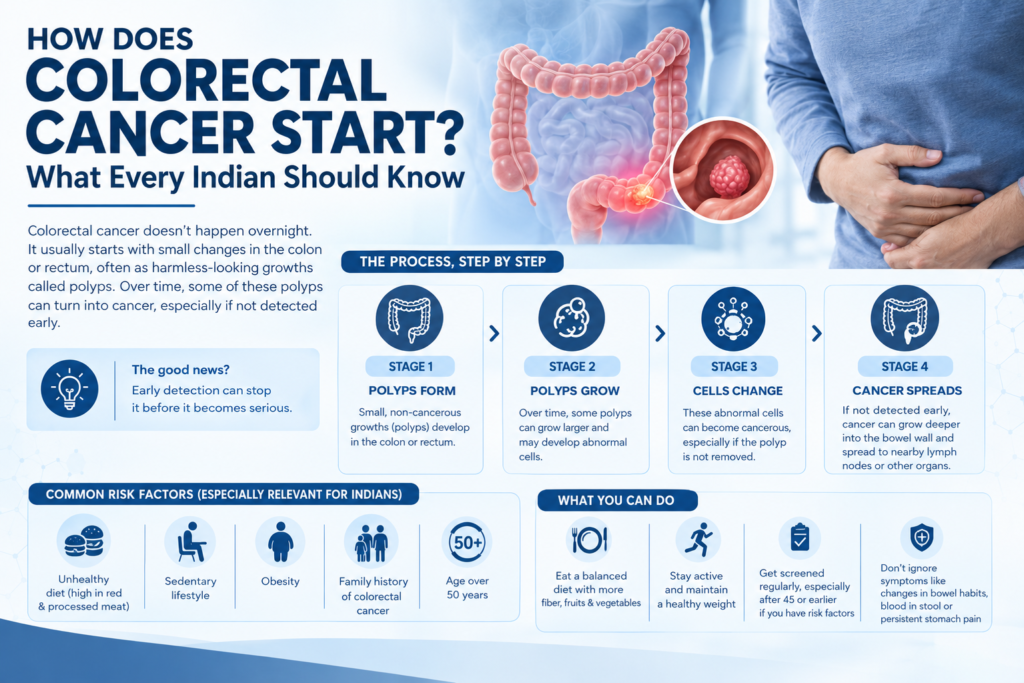
We usually expect a serious illness to announce itself with pain or obvious warning signs. Colorectal cancer often doesn’t. It starts quietly inside the large intestine, sometimes years before anyone feels unwell. The encouraging part is that this slow start gives us something few cancers do.
What Is a Polyp, And Should You Be Worried?
This microscopic pileup of confused cells forms a small, fleshy bump on the inner wall of the colon. That bump is called a polyp.
There are two types:
- Hyperplastic polyps — These are completely harmless. They stay small, cause no trouble, and never turn into cancer. Most polyps fall into this category.
- Adenomas — These are the ones that matter. An adenoma is a precancerous polyp. It is not cancer yet — but given enough time and the right conditions, it has the potential to become one.
The 10 to 15 Year Window
Here is the most important fact. An adenoma doesn’t turn into cancer in days or weeks. On average, it takes around 10 to 15 years.
My honest take is that colorectal cancer isn’t dangerous only because of the disease itself. It’s dangerous because of the delay. When a polyp is found and removed, the cancer never gets a chance to happen. Few conditions give us that kind of head start, and it’s a shame to waste it.
Why Do Polyps Form?
Doctors group the causes into two buckets.
- Sporadic (about 90% of cases)
These happen by chance, mainly through ageing and lifestyle. As we get older, the body’s “spell checker” misses more mistakes. Common contributors include:
- A diet heavy in ultra-processed food and red or processed meat
- Very little fibre
- Smoking and tobacco
- Heavy alcohol use
- A sedentary routine
- Genetic (about 10% of cases)
Some people are born with a fault in their DNA repair system. The best-known example is Lynch syndrome. Imagine being born without the right toolkit to fix everyday cell errors. In such families, polyps can turn cancerous much faster, sometimes in the 30s or 40s. That’s why family history matters. If a parent, brother, or sister has had colon cancer, your screening plan changes.
How a Polyp Becomes Cancer
Your colon lining sits on a foundation layer called the basement membrane. While abnormal cells stay above it, they are just a polyp, contained in one place. Cancer begins when a later change lets those cells break through the membrane and invade the deeper muscle layer. Beneath it lie blood vessels and lymph nodes, which can carry cancer cells to other organs like the liver or lungs. This is why catching problems early makes such a difference.
You Can Stop This Before It Starts
The origin story of colorectal cancer is not a story of bad luck. It is a story of missed opportunities, and we now have the tools to stop missing them.
Dr. Viraj Lavingia, one of Ahmedabad’s leading GI medical oncologists specialising in colorectal cancer, puts it simply: “This is a slow-moving train. We can see it coming from a mile away. We just need people to show up for their screenings.”
Colonoscopies, stool tests, and simple lifestyle changes- these are not scary things. They are the tools that stop cancer before it even gets a chance to start. You do not have to be a victim of this timeline.
What You Can Do Now
- Know your family history- ask relatives about colon cancer or polyps. It’s one of the most useful health conversations you can have.
- Eat more fibre. Dal, seasonal sabzi, fruits, whole grains, and salads all help. Go easy on packaged snacks, fried foods, and processed meats.
- Move daily. Even a brisk 30-minute walk counts.
- Avoid tobacco in all forms, and limit alcohol.
- Ask about screening. A colonoscopy lets doctors find and remove polyps before they cause harm. Ask your doctor when you should start, especially if colon cancer runs in your family.
- Don’t ignore persistent changes. Blood in the stool, a lasting change in bowel habits, unexplained weight loss, or constant tiredness deserve a check-up. These signs can have many causes, but they shouldn’t be brushed aside.
The Takeaway
Colorectal cancer is often described as a slow-moving train that we can see coming from a long way off. You have time to act, but only if you choose to use it. Fear keeps too many people from asking questions, so start the conversation with your family and your doctor. As Dr. Viraj Lavingia often reminds his patients, awareness and timely screening are your strongest tools.