
What Does Your Cancer Stage Actually Mean?
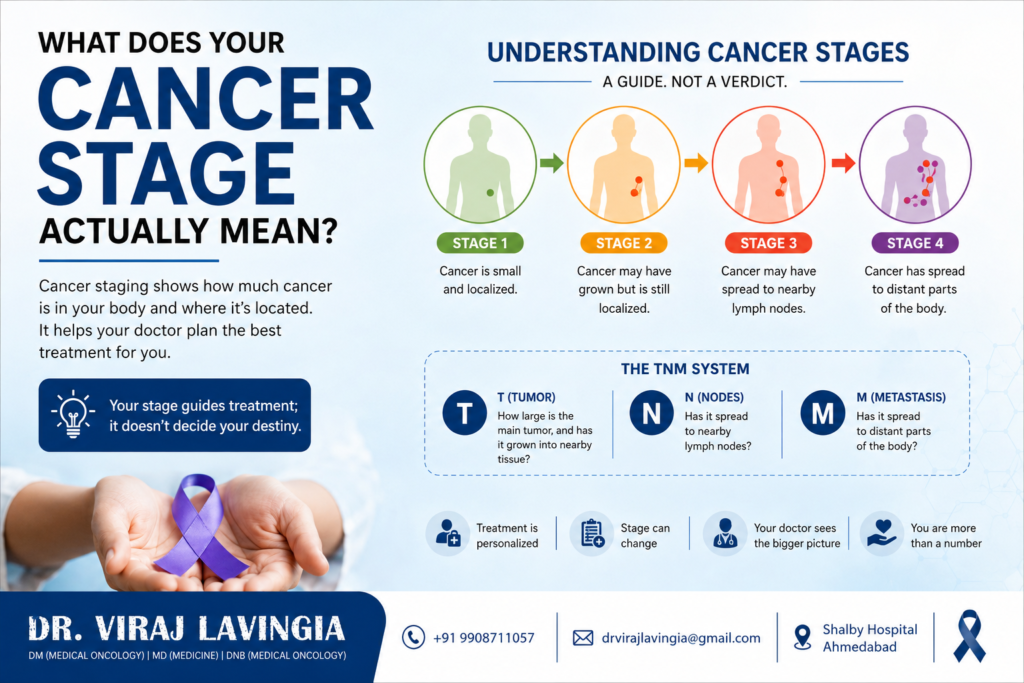
Hearing the word “stage” after a cancer diagnosis can feel like the ground has shifted under your feet. Stage 1. Stage 3. Stage 4. For most people, these numbers land like a verdict, as if they already know how the story ends.
They don’t.
As a practicing Medical Oncologist in Ahmedabad, Dr. Viraj Lavingia meets this fear in his clinic almost every week. Patients walk in holding a report, convinced their stage number has already decided their future. It hasn’t. Staging is a tool doctors use to understand and treat cancer, not a prediction carved in stone.
Let’s break down what staging really means, in plain language.
So, What Is Cancer Staging, Really?
In simple terms, staging tells your doctor how much cancer is in the body and where it’s located. That’s it. It’s a snapshot, not a sentence.
Doctors usually rely on something called the TNM system to work this out:
- T (Tumor): How large is the main tumor, and has it grown into nearby tissue?
- N (Nodes): Has it spread to nearby lymph nodes?
- M (Metastasis): Has it spread to distant parts of the body?
These three pieces of information are combined to give an overall stage usually from Stage 1 (early, localized) to Stage 4 (spread to other organs).
Note: These are approximate standard-dose costs for a single cycle. Most patients require 4 to 6 cycles spaced two to three weeks apart at the beginning, and based on the results, may extend up to one year. The hospital infrastructure—such as corporate daycare charges versus trust-based center fees—also affects the final bill.
Why Do Doctors Even Need This Number?
Because treatment isn’t one-size-fits-all. A Cancer Specialist uses the stage to decide the right course of action, surgery, chemotherapy, radiation, targeted therapy, or a combination.
Think of it like a map. It tells the doctor where things stand right now, so they can plan the best route forward. Without staging, treatment would essentially be guesswork.
The Myth That Needs Busting
Here’s where most of the fear comes from: people assume stage equals prognosis, that a higher stage automatically means a shorter or harder life. This isn’t accurate, and it’s important to say that clearly.
A few things staging does not tell you:
- It doesn’t predict your individual outcome. Two people with the same stage can have very different journeys, depending on overall health, cancer type, and how the body responds to treatment.
- It isn’t permanent. Stage is usually set at diagnosis (clinical stage) and may be reassessed after surgery or treatment (pathological stage); it can shift as more information becomes available.
- It doesn’t replace your doctor’s full assessment. Age, general health, genetics, and even the specific subtype of cancer all play a role in how things unfold — not just the stage number.
This is really the heart of the idea: your stage guides treatment; it doesn’t decide your destiny.
Different Cancers, Different Staging Approaches
It’s worth knowing that staging isn’t identical across all cancers. For example, blood cancers like leukemia are often not staged the same way as tumor-based cancers, since they behave differently in the body. This is one of many reasons a personalized conversation with your Cancer Specialist matters more than comparing notes with someone else’s diagnosis, even if the stage number sounds the same.
For a deeper, stage-by-stage breakdown, from Stage 1 all the way to Stage 4, Dr. Viraj Lavingia’s detailed guide on cancer staging walks through what each stage typically involves and how treatment approaches shift accordingly.
The Bigger Picture
A cancer diagnosis brings enough uncertainty on its own. Understanding what staging actually means, and, just as importantly, what it doesn’t mean, can take some of that fear out of the room.
If there’s one thing to hold onto, it’s this: staging is information, not a forecast. Your care team, your response to treatment, and the choices you make along the way matter just as much, if not more, than the number on your report. Connecting with an experienced Medical Oncologist can help turn uncertainty into a clear, actionable plan.