
Cost of Immunotherapy in Ahmedabad: An Oncologist's Guide for Patients
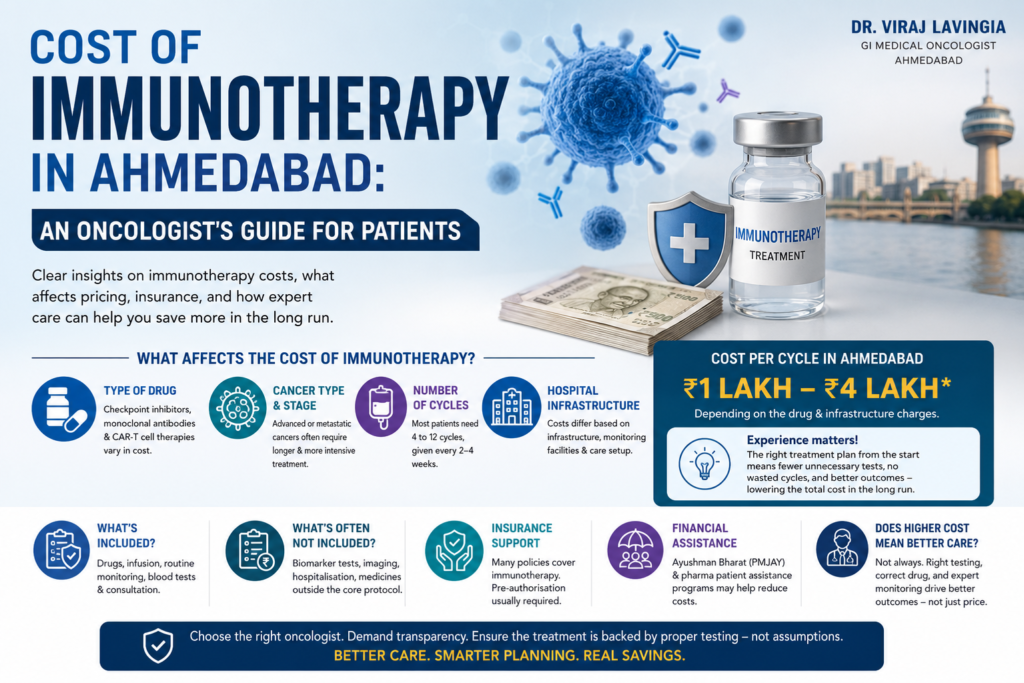
Immunotherapy has changed what’s possible in cancer treatment, but it remains one of the most expensive options available today. As a Medical Oncologist who has spent over a decade treating cancer patients in Ahmedabad, I’ve noticed that the real source of patient anxiety usually isn’t the decision to start treatment. It’s the uncertainty around what the bill will actually look like and why costs vary so much depending on where you go. If you are evaluating immunotherapy, you deserve complete transparency. Here is a breakdown of what these drugs actually cost, how Patient Assistance Programs (PAPs) work, and how we leverage clinical data to make these treatments significantly more affordable without compromising outcomes.
The True Cost of Immunotherapy Drugs (Per Cycle)
The single biggest factor in your bill is the drug itself. Pharmaceutical companies offer Patient Assistance Programs (PAPs) to help offset the financial burden, usually structured as “Buy X, Get Y free.” I ensure my patients have direct access to these programs so they only pay the subsidized rate. Here is a realistic look at the standard-dose costs for the most common immunotherapy drugs in India before and after PAPs (as of 15th July 2026):
| # |
Drug (Brand Name)
|
Standard Dose
|
Approx. MRP Per Cycle
|
Typical Patient Assistance Program (PAP)
|
|---|---|---|---|---|
1 |
Pembrolizumab (Keytruda) |
200 mg |
₹4,00,000 |
Merck Access Program (Typically "Buy worth of 10L, Get remaining free for a year” or similar) |
2 |
Nivolumab (Opdyta) |
240 mg |
₹2,50,000 |
BMS Support (Typically "Buy 4, Get 20" or similar) |
3 |
Tislelizumab (Tevimbra) |
200 mg |
₹1,20,000 |
Glenmark PAP (e.g., "Buy 5, Get 12" or similar) |
4 |
Toripalimab (Zytorvi) |
240 mg |
₹1,20,000 |
Dr. Reddy's PAP (e.g., "Buy 5, Get 12" or similar) |
5 |
Serplulimab (Hetronifly) |
300 mg |
₹60,000 - ₹70,000 |
Intas PAP (e.g., "Buy 2, Get 1" or similar) |
Note: These are approximate standard-dose costs for a single cycle. Most patients require 4 to 6 cycles spaced two to three weeks apart at the beginning, and based on the results, may extend up to one year. The hospital infrastructure—such as corporate daycare charges versus trust-based center fees—also affects the final bill.
Why Immunotherapy is More Affordable at Our Center: The Science of Low-Dose
While the standard doses listed above are approved by regulatory bodies, a standard dose does not always mean a better outcome. The reason immunotherapy at my center is often much more affordable is that we frequently utilize low-dose immunotherapy regimens when clinically appropriate.
Unlike traditional chemotherapy, where efficacy relies on the maximum tolerated dose, immunotherapy works by activating your immune system. Once your immune receptors are saturated, giving more of the drug simply inflates the cost without improving the cancer-fighting effect.
We now have tremendous datasets from leading Indian institutions that prove low-dose regimens can yield the exact same—or even better—results:
• The DELII Study (Tata Memorial Hospital, 2026): Dr. Kumar Prabhash and his team demonstrated that an ultralow dose of Nivolumab (just 20 mg every 2 weeks, compared to the standard 240 mg) significantly improved overall survival in patients with head, neck, and lung cancers. By using a 20 mg dose, the drug cost per cycle drops from over ₹2 Lakhs to roughly ₹23,000.
• The PLANeT Trial (AIIMS New Delhi, 2026): This study showed that adding a flat, low dose of Pembrolizumab (50 mg instead of the standard 200 mg) to chemotherapy for triple-negative breast cancer resulted in excellent pathological complete response (pCR) rates.
• Advanced NSCLC Data (ASCO 2026): Further trials from Tata Memorial confirmed that low-dose Pembrolizumab combined with chemotherapy significantly improved overall survival in advanced Non-Small Cell Lung Cancer without new safety signals.
• ASCO GI 2025 (dMMR/MSI Cancers): Real-world Indian data presented by our team evaluated standard versus alternative low-dosing of immunotherapy in patients with non-colorectal cancers that are deficient in mismatch repair (dMMR/MSI). The study found that patients receiving low-dose immunotherapy actually had a 12-month overall survival rate of 72%, compared to 69% in the standard-dose cohort, confirming that low doses are highly effective for these specific biomarkers.
• Large Observational Data (Eur J Cancer / ESMO 2025 context): A massive systematic review evaluating the realworld, post-commercialization use of low-dose anti-PD-(L)1 therapies across more than 30 studies and over 2,000 patients demonstrated robust radiological responses even when doses were a fraction of those approved by regulatory agencies. This broad dataset firmly establishes that maximal dosing is not a prerequisite for maximal benefit. By basing our treatment plans on these rigorous, India-specific trials, we can deliver world-class oncology care at a fraction of the corporate hospital price.
What It Costs Under Dr. Viraj Lavingia's Care
When you look at the total course of treatment, the real savings come from precision and experience. Two clinics offering what looks like identical therapy can land on very different totals.
Why the total treatment course under my care tends to be lower:
• Evidence-Based Dosing: We use low-dose immunotherapy (like 40 mg Nivolumab or 100 mg Serplulimab) whenever the data supports it for your specific cancer.
• No Wasted Cycles: The right drug is selected from the first cycle based on your actual biomarkers (like PD-L1 or MMR status)—not trial and error.
• Total Transparency: No bundled charges. You know exactly what the drug costs and what the hospital charges.
Does a Higher Price Always Mean Better Treatment?
Not necessarily, and this is where many patients get it wrong. What actually determines a good outcome is correct biomarker testing before starting therapy, the right drug selected for your specific cancer, careful monitoring for side effects, and an oncologist who has real hands-on experience managing these protocols.
A poorly monitored, “cheaper” standard-dose plan can end up costing more in the long run if complications are caught too late. Conversely, paying a premium for a standard dose when a low-dose regimen is scientifically proven for your cancer is simply burning through your financial resources.
Immunotherapy costs in Ahmedabad can vary quite a bit, but the decision shouldn’t be based on price alone. Choose the right oncologist, insist on full transparency around costs and PAPs, and make sure the treatment plan is backed by proper testing and the latest data rather than assumption.