
Why Does Rectal Cancer Need Radiation When Colon Cancer Does Not?
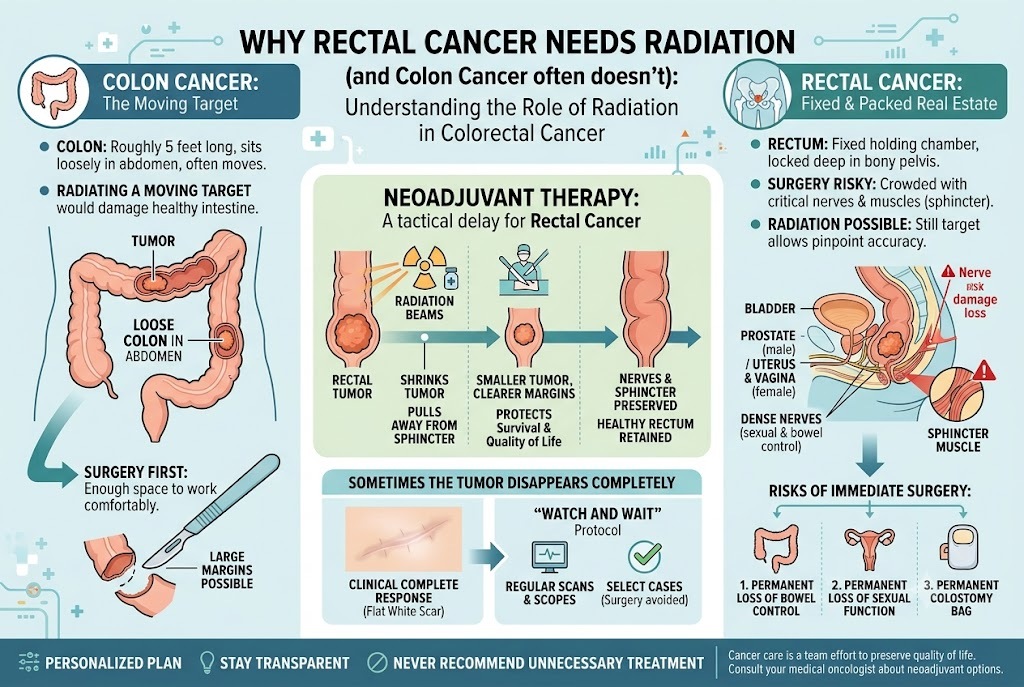
In real estate, everyone knows the golden rule: location, location, location. What most patients don’t realise is that the same rule applies to cancer.
Picture two patients with an identical tumour, same size, same genetic mutation. The only difference is where it sits. One is in the upper colon, the other right at the end of the digestive tract, in the rectum. As a Medical Oncologist, I can tell you these two cases are never treated the same way. The location alone changes the entire battle plan.
The Crowded Real Estate of the Pelvis
Your colon is roughly five feet long and sits fairly loosely in the abdomen; it has room to shift and move. If a surgeon needs to remove a section of it, there’s enough space to work comfortably.
The rectum is a different story altogether. It’s the final holding chamber before waste leaves the body, and it sits locked deep inside the bony pelvis, one of the most tightly packed regions in the human body.
Right next to the rectum, you’ll find:
- The bladder
- The prostate (in men) or the uterus and vagina (in women)
- A dense network of nerves controlling sexual function and bowel control
- The sphincter muscle, the valve that keeps waste from leaking out
This tight packing is exactly what makes rectal cancer so tricky to operate on.
Why Immediate Surgery Is So Risky Here
If a surgeon goes straight in with a scalpel to remove a rectal tumour, getting clean margins around the cancer can mean cutting nearby nerves or removing the sphincter muscle entirely.
The consequences of that are life-changing, not just medically but personally:
- Permanent loss of sexual function
- Permanent loss of bladder control
- A permanent colostomy bag
For decades, this was simply accepted as the cost of survival. Modern oncology decided that wasn’t good enough anymore.
Enter Radiation: A Tactical Delay
Instead of operating immediately, doctors often use a “tactical delay”, radiation therapy, before surgery even happens.
Radiation uses focused, high-energy beams to damage the DNA inside cancer cells. It isn’t used for colon cancer simply because the colon moves around too much inside the abdomen; radiating a moving target would end up damaging the healthy intestine along the way.
The rectum, though, is fixed in place inside the pelvis. That stillness is what makes it possible to aim radiation with pinpoint, millimetre-level accuracy directly at the tumour.
What Is Neoadjuvant Therapy?
This pre-surgery approach has a name: neoadjuvant therapy, meaning treatment given before surgery.
Typically, it looks like this:
- Radiotherapy is given daily, or sometimes weekly
- It’s often paired with a chemotherapy pill that makes the radiation more effective
- Over several weeks, the tumour gradually shrinks and pulls away from the sphincter muscle
- By the time surgery happens, the tumour is smaller, and the margins are far clearer
The result: surgeons often get enough space to remove the cancer while preserving the nerves and sphincter, protecting both survival and quality of life.
When the Tumour Disappears Completely
Sometimes, radiation and chemotherapy work so well that by the time doctors scan the patient before surgery, there’s no visible tumour left at all, just a flat white scar where it used to be.
This is called a clinical complete response, and it raises a genuinely radical question: if the cancer already appears gone, is major surgery still necessary?
In select cases, the answer is no. This is where a newer protocol called “watch and wait” comes in — instead of operating, doctors monitor the patient closely with regular scans and scopes every few months. If the cancer doesn’t return, many patients keep their rectum and normal bodily function without ever needing surgery.
The Bigger Picture
Rectal cancer treatment is a genuine team effort, a Medical Oncologist, a radiation oncologist, and a colorectal surgeon working together to build a plan specific to that patient’s own anatomy. As Dr. Viraj Lavingia often explains, cancer care today isn’t just about survival anymore; it’s about preserving the person’s quality of life alongside it.
If you or a loved one has been diagnosed with rectal cancer, ask your treating team whether neoadjuvant radiation is part of your plan, and whether a watch-and-wait approach could realistically apply to your case.