
Why Doesn't a Clean CT Scan Always Mean You're Cancer-Free?
A “clean” CT scan report is often treated as the finish line of cancer treatment. Family members celebrate, patients finally start sleeping better, and life slowly begins to feel normal again.
But there’s something important that doesn’t always get explained clearly at that moment: a clean scan tells you there’s nothing visible, not that there’s nothing left. And that one-word difference matters more than most people realise.
This isn’t meant to alarm anyone. It’s simply how modern imaging technology works, and understanding it is exactly what an experienced medical oncologist wants every patient and caregiver to know before they read too much into a single report.
Why Scans Have a Blind Spot
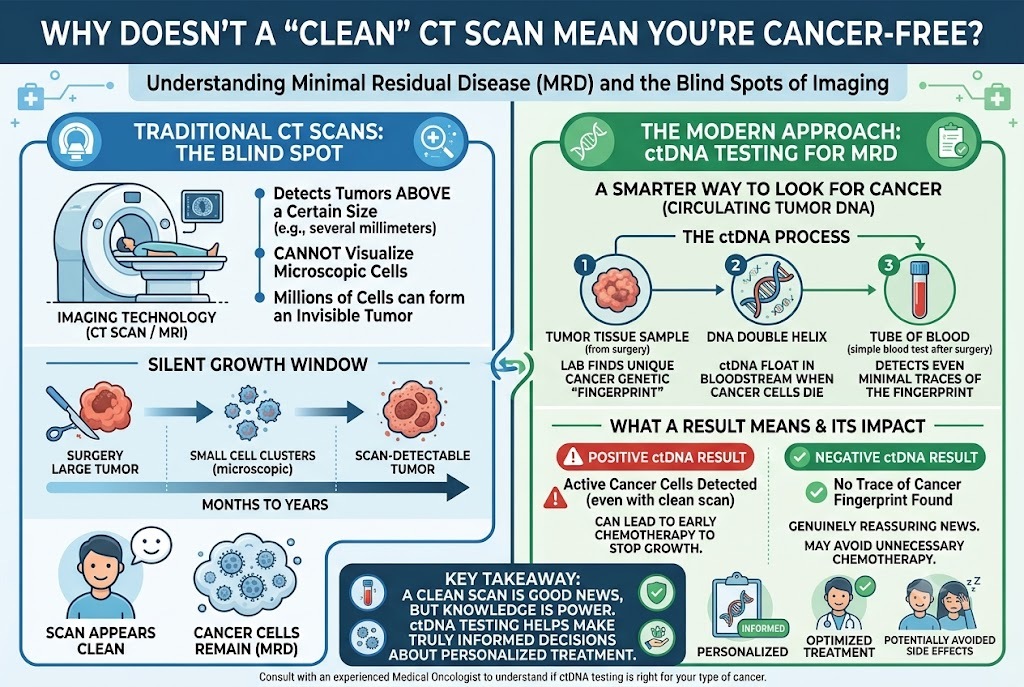
A CT scan or MRI can only flag a tumour once it grows to a certain size, typically a few millimetres across. That sounds tiny, but here’s the part that surprises most people:
- A tumour that size can already contain tens of millions of cells
- Anything smaller than that simply doesn’t register on the image, no matter how advanced the machine is
- This isn’t a flaw in the technology, it’s just a physical limit of imaging itself
So consider this scenario: surgery successfully removes the main tumour, but a handful of cancer cells, maybe a few hundred, maybe a few thousand, remain scattered somewhere in the body. They’re active, but they’re microscopic. On a scan, they’re invisible.
Left alone, these cells can quietly grow for months, sometimes even years, before they become large enough for any scan to detect. That silent window is exactly why “clean” and “cured” aren’t always the same thing.
What Is Minimal Residual Disease (MRD)?
In oncology, these invisible leftover cells have a name: Minimal Residual Disease, or MRD for short.
For decades, MRD was the biggest challenge in cancer care, because:
- Doctors couldn’t see these cells on any scan
- They had to rely on statistics and probability, not real proof
- To be safe, many patients were given months of chemotherapy “just in case,” even if they were already cancer-free after surgery
It was, in a way, a precaution taken without certainty, necessary, but not always accurate.
Enter ctDNA: A Smarter Way to Look for Cancer
This is where modern cancer care has taken a genuine leap forward, through something called circulating tumour DNA, or ctDNA.
Here’s how it works, step by step:
- When your tumour is surgically removed, a small piece is sent to a genetic lab
- The lab studies its DNA and identifies the exact genetic “fingerprint” unique to your cancer
- Cancer cells constantly die and get replaced, and when they die, they release tiny fragments of their DNA into your bloodstream
- A few weeks after surgery, a simple blood test checks whether that same fingerprint is floating in your blood
No scan. No radiation. Just a tube of blood.
What a Positive or Negative Result Actually Means
If the ctDNA test comes back positive: it means there are still active cancer cells somewhere in the body, even if your CT scan looks perfectly clean. This usually leads to starting chemotherapy right away, before those cells get a chance to grow.
If the test comes back negative: it means no trace of that cancer fingerprint was found in your blood. This is genuinely reassuring news, and it opens the door to something many patients don’t expect.
The Real Benefit: Avoiding Unnecessary Chemotherapy
If a patient is found to be MRD-negative, many oncologists can now consider skipping chemotherapy altogether, and simply monitor the blood every few months instead.
That means potentially avoiding:
- Nausea and fatigue
- Nerve-related side effects
- Months of physical and emotional strain
This shift matters because cancer treatment is no longer based purely on statistics; it’s based on what’s actually happening inside your body right now.
As Dr Viraj Lavingia often explains to patients, the goal isn’t to guess anymore; it’s to know. And ctDNA testing is helping make that possible for many colorectal cancer patients today.
When Should You Consider ctDNA Testing?
If you or a loved one is preparing for cancer surgery, especially for colorectal cancer, it’s worth having an open conversation with your treating doctor about:
- Whether ctDNA testing is appropriate in your case
- What a positive or negative result would mean for your treatment plan
- Whether chemotherapy can be safely reduced or avoided
Every case is different, and only a qualified Medical Oncologist can guide you based on your specific reports, cancer type, and overall health.
A clean scan is good news. But understanding what it can and cannot tell you is what helps you make truly informed decisions about your health.